
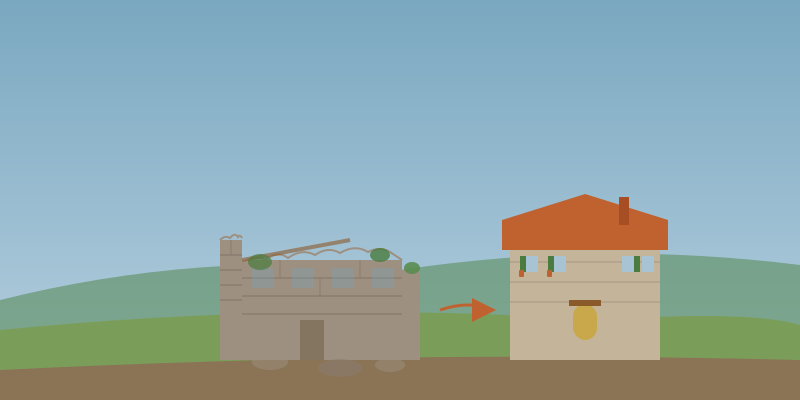
Renovating a Stone House or Ruin in Central Portugal
The restoration of a traditional Portuguese stone house — from roofless ruin to comfortable home — is one of the most rewarding property projects available to international buyers in Europe today. It is also, done properly, entirely achievable. This guide draws on 16 years of watching buyers navigate the process in central Portugal: the mistakes to avoid, the steps that matter, and the costs you should realistically budget.
Why Renovate a Ruin?
The case for buying a ruin rather than a renovated house comes down to three things: character, value, and creative control.
Character: A stone house built in 1880 in a village in Coimbra or Castelo Branco district was built with materials from the immediate landscape — local granite or schist, clay roof tiles, lime mortar, chestnut beams, flagstone floors. The result has a quality — thick walls, generous proportions, embedded in the landscape — that new construction cannot replicate. When restored with appropriate materials and craftsmanship, these houses are extraordinary.
Value: A ruin in a central Portugal village that cost €35,000 to buy and €95,000 to restore is a house you own for €130,000. A comparable renovated house, if you could find one — 120 square metres, stone construction, 1,000 square metre plot, village location — might cost €165,000 to €200,000 if bought ready-made. The renovation route is, in most cases, the better financial deal.
Creative control: Renovating from scratch means you specify the kitchen, the bathroom layout, the heating system, the windows, the insulation standard, the external garden. You are not inheriting someone else’s choices and compromises.
Understanding What You Are Buying
The term “ruin” in Portuguese property advertising covers a spectrum from “structurally sound, needs a new roof and interior” to “four walls at various states of collapse, vegetation growing through the floor, borderline dangerous to enter.” It is essential to understand which category your prospective ruin falls into before committing.
The walls: In central Portugal, most traditional houses have walls of either granite or schist, typically 50 to 80cm thick. These walls are enormously durable and the main structural asset of the building. A building with intact load-bearing walls — even without a roof, without floors, without windows — is a building that can be restored to a habitable standard.
The structure to assess:
- Are the walls vertical? (Small lean is acceptable; significant lean means structural intervention)
- Are there cracks? (Hairline is normal; separation cracks may indicate movement)
- Is the floor plan clear? (Ground-floor stone walls usually survive even when upper floors have collapsed)
- Are outbuildings included? (Adega, stable, wood store — these add space and character)
- What is the plot? (Garden, well, water rights, agricultural land)
Professional survey: We strongly recommend appointing a Portuguese architect or structural engineer (engenheiro) to inspect any ruin before you commit to purchase. Cost: €300 to €600 for an initial report. This will tell you whether the walls are sound, whether there are drainage or foundation issues, and give a realistic preliminary view of what restoration will cost.
The Planning Permission Process
Renovation of a traditional house in Portugal requires planning permission (licença de obras) from the Câmara Municipal (local council). The process varies slightly between municipalities but follows a standard national framework.
PDM (Plano Director Municipal): Every Portuguese municipality has a PDM — a master plan — that classifies land use. Rural properties may fall within different classifications:
- Solo urbano: Urban zone — full construction rights
- Solo rústico: Rural zone — restricted construction rights
- Solo de edificação dispersa: Dispersed construction zone — intermediate rights
For ruins in rural zones, Portugal has specific legislation (Regime Jurídico da Urbanização e Edificação) that permits the reconstruction and expansion of existing footprints in many circumstances. The key point: you can generally rebuild what was there, and in some cases extend modestly.
The processo de obras (works process):
- Appoint a Portuguese architect (required by law for all works requiring planning permission)
- Architect prepares a project (projeto) including drawings, materials specification and technical reports
- Submit the project to the Câmara Municipal (local council)
- Câmara review period: typically 30 to 90 days for straightforward projects
- Receive licença de obras (works licence)
- Commence works — architect visits site at key stages
- On completion, architect applies for licença de utilização (use/habitation licence)
- Câmara inspection confirms works match approved project
- Licença de utilização issued — property is legally habitable
Processing times: Câmaras in central Portugal vary considerably in their efficiency. Some (Tomar, Fundão) are known for relatively smooth processes; others can be slower. Allow 3 to 6 months for planning permission from initial application to approval.
Aldeias de Xisto: Properties in the officially recognised Schist Village network (Aldeias de Xisto) are subject to specific aesthetic guidelines — materials, colours, window types — to preserve the village character. This is not onerous in practice (it essentially means using traditional schist and lime mortar, which is what you should be using anyway) but it is worth understanding from the start.
Choosing Your Architect
Your architect is your most important professional appointment for a renovation project in Portugal. The architect will:
- Prepare the planning application project
- Design the interior layout and oversee the technical specifications
- Coordinate with structural engineers, electrical and mechanical engineers
- Supervise the works on site (if you appoint them for this role — separate from the basic project fee)
- Sign off on the completion certificate
Architect fees: For a renovation project, Portuguese architects typically charge 8% to 14% of the construction cost, depending on the scope of services and the size of the project. For a €100,000 renovation, expect architect fees of €8,000 to €14,000 for a full service including site supervision.
We maintain relationships with architects who specialise in traditional stone house renovation across our six districts. All speak English.
The Construction Budget
The most common mistake made by buyers coming to central Portugal with renovation projects is underestimating the construction cost. This is understandable — the property was bought for €30,000, the village feels very cheap, and figures from the internet suggesting “€500 per square metre” create unrealistic expectations.
Realistic construction costs (2024–25):
| Specification Level | Cost per m² | Notes |
|---|---|---|
| Basic habitable (functional but modest) | €700 – €900/m² | Solid roof, basic plumbing, simple kitchen, no luxury finishes |
| Good residential standard | €900 – €1,200/m² | Good insulation, underfloor heating option, quality kitchen and bathroom |
| High specification | €1,200 – €1,600/m² | Architect-quality finishes, high-grade materials, bespoke joinery |
For a 120m² ruin restored to a good residential standard, the construction budget should realistically be €108,000 to €144,000 — before architect fees, planning costs, and the inevitable contingency budget (allow 10–15% contingency).
The cost of traditional materials: Traditional stone house restoration involves lime mortar rather than cement (essential for the walls to breathe), hydraulic lime render, traditional clay roof tiles (telha portuguesa or telha árabe), chestnut or pine structural beams where original ones are damaged, and flagstone or terracotta floor tiles. These materials cost more than modern equivalents but produce a better result in an old stone building. Cement and gypsum used in old stone buildings cause long-term damage through moisture trapping.
Finding and Managing Builders
Local builders (empreiteiros): Central Portugal has a solid tradition of local building contractors who understand traditional construction. In each of our districts, there are builders with 20 to 30 years of experience in stone house restoration. Prices are generally lower than in the Algarve or near Lisbon.
Getting quotes: Your architect can produce a bill of quantities (mapa de quantidades) for competitive quoting. We recommend getting three quotes for any renovation project over €50,000.
Payment terms: Portuguese builders typically work on staged payments tied to completion of defined phases of work: foundation/damp-proof, walls/structure, roof, first-fix plumbing and electrical, plastering, second-fix, finish. Avoid paying large amounts in advance of work being done.
Day-rate workers (jornaleiros): For smaller projects, it is possible to hire individual skilled workers by the day — masons (pedreiros) for stonework, carpenters (carpinteiros) for joinery. Day rates for skilled tradespeople in central Portugal are €80 to €130 per day (lower in Castelo Branco, higher near Coimbra or Leiria). This approach requires you to be present (or have a trusted project manager) on site regularly.
Traditional Features to Preserve
A central Portugal stone house restored well should retain:
- The stone walls: Never render or cladding the exterior in anything but lime-based materials, which allow the stone to breathe
- The lareira: The traditional open fireplace, typically in the kitchen — the heart of the house
- Exposed stone: Interior stone walls, left clean or washed with lime, are beautiful
- Original floor materials: Flagstone (lousa, pedra de Lousã), terracotta tiles (tijoleira) or wood boarding
- The roof line: Traditional Portuguese terracotta tiles on a simple pitch — avoid changing the roof form
- The telheiro: The covered external area (lean-to) attached to many traditional houses — excellent for outdoor dining, preserving it adds character
Renovation Costs: A Realistic Example
A 2024 renovation project we accompanied in Penela, Coimbra district:
- Property purchase: schist T2 ruin, 110m², 600m² plot — €32,000
- Architect fees (project + site supervision): €11,000
- Planning permission fees: €850
- Construction (to good residential standard, includes new roof, all services, kitchen, 2 bathrooms): €112,000
- Contingency (used for unforeseen foundation drainage issue): €9,500
- Total investment: €165,350
The resulting property — a two-bedroom stone house in a village 25 minutes from Coimbra, with walled garden, traditional features, modern heating and insulation — was valued on completion at €195,000 to €215,000.
Our renovation support service: We help buyers identify suitable renovation projects across central Portugal, introduce them to qualified architects, and provide practical support throughout the process. We do not charge extra for this — it is part of how we work. If renovation is your route, we're experienced at managing the process from the initial property search through to collecting the keys on completion.