

Property for Sale in Central Portugal
Houses, farms, quintas and land in the most authentic part of Portugal — from €30,000 ruins with character to working farms and lovingly restored stone houses. Specialists since 2007.
Why Central Portugal?
While tourists crowd Porto and the Algarve, central Portugal remains quietly, stubbornly itself — a landscape of granite mountains, schist villages, Roman bridges and olive groves that has changed little in centuries. And the property prices reflect it.
Central Portugal stretches from the Atlantic coast near Leiria inland through the rolling hills of the Mondego valley, across the vineyards of the Dão and up into the high ground of Castelo Branco approaching the Spanish border. It is a region of extraordinary variety — university city and medieval village, Atlantic coast and mountain plateau, Roman aqueduct and Knights Templar fortress.
For UK buyers, central Portugal offers what the Algarve stopped offering a decade ago: genuine rural character, genuine value for money, and properties that have never appeared on Rightmove. A T2 stone house in a village near Penela might cost €75,000. A half-hectare ruin with outbuildings in the hills above Góis might be €35,000. A working quinta with olive grove and vineyard near Arganil — the kind of property that would appear in a Sunday supplement — might still be found for €180,000 to €240,000.
We have been selling property in central Portugal since 2007, when this site first went live. In that time we have helped hundreds of British, Irish, Dutch and German buyers find homes here — some looking for holiday houses, others for permanent relocation, a growing number seeking agricultural land or renovation projects. We know the local notaries, the câmaras municipais, the trustworthy architects and the surveyors who understand schist construction. We speak English and Portuguese fluently.
A note on what "central Portugal" means. Estate agents sometimes stretch the term loosely. We are precise about it: we cover the districts of Coimbra, Leiria, Santarém, Castelo Branco and Viseu — plus the municipality of Tomar which straddles Santarém and the region historically known as Ribatejo. We do not cover the Algarve, the Alentejo south of the Tagus, or Porto and the north. If you want central Portugal specialists, you've found them.
What Kind of Property Can I Find?
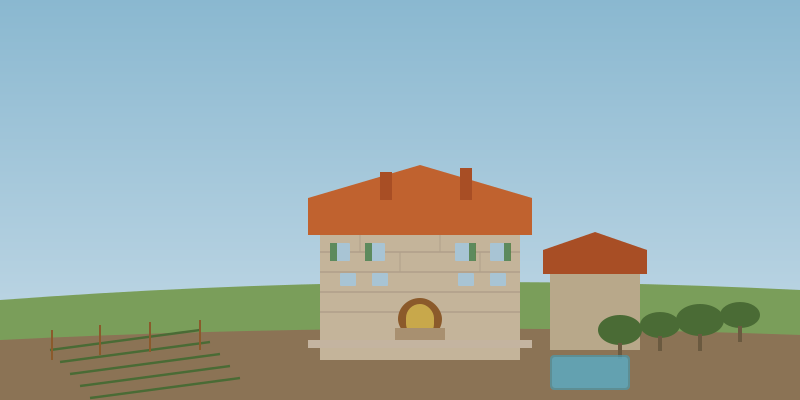
Central Portugal's property market is wonderfully varied. At the affordable end, you have the ruins and restoration projects — typically schist or granite farmhouses that have been empty for a generation, standing in small plots with outbuildings and sometimes a well. Prices start at around €25,000 to €40,000 for the property itself, with restoration budgets typically running another €60,000 to €120,000 depending on the extent of work and what specification you're building to.
Then there are the habitable stone houses — T2 and T3 properties in villages that are liveable but may need modernising. Kitchen, bathroom, electrical rewire, new windows. Budget €70,000 to €110,000 to buy and a further €20,000 to €40,000 to bring to a comfortable modern standard. In villages like Miranda do Corvo, Proença-a-Nova or Ansião, these represent genuine value.
At the top end, the quintas — traditional Portuguese farmsteads — combine the house with working or potential agricultural land. Olive groves, vineyards, cork oak, eucalyptus plantation, market garden. A serious quinta with 5–15 hectares and a restored house in Coimbra district starts at around €200,000 and rises to €500,000 or beyond for something special near Viseu or Tomar.
Property Types & Price Ranges
Central Portugal offers the full range, from €25,000 ruins to restored quintas over €400,000. Here's what your budget buys.
| Property Type | Location Example | Typical Price Range | Notes |
|---|---|---|---|
| T2 ruin with land | Góis, Arganil, Sertã | €25,000 – €50,000 | Shell only, add €60–120k restoration |
| Habitable T2 village house | Ansião, Miranda do Corvo, Penela | €65,000 – €95,000 | Needs modernising but liveable |
| Renovated T3 stone house | Near Coimbra, Tomar, Leiria | €110,000 – €175,000 | Move-in ready, often with garden |
| Small quinta (1–3 ha) | Coimbra or Viseu district | €150,000 – €260,000 | Farmhouse + outbuildings + land |
| Working quinta (5–15 ha) | Santarém, Castelo Branco | €220,000 – €480,000 | Olive grove, vineyard, or cork oak |
| Agricultural land only | Ribatejo, Beira Baixa | €3,000 – €8,000/ha | Irrigated land at higher end |
Explore the Regions
Central Portugal is not one place — it is six distinct regions, each with its own character, property market and appeal.
The Renovation Opportunity
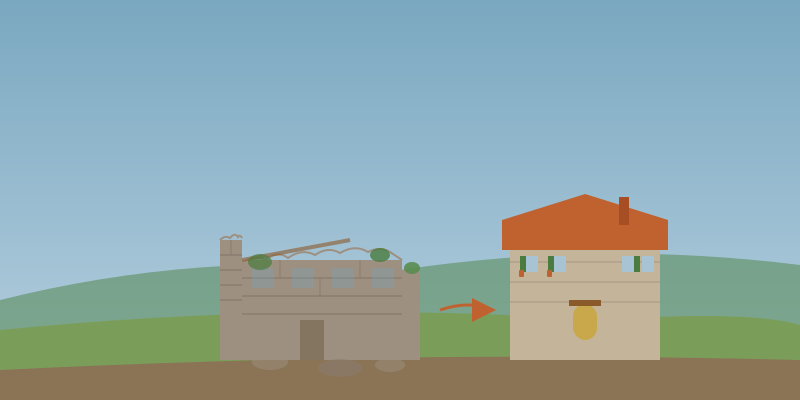
One of the great attractions of central Portugal for British buyers is the abundance of renovation projects — properties with genuine architectural character, local stone construction, traditional features like lareira fireplaces and telheiro outbuildings — at prices that simply do not exist elsewhere in Western Europe.
A ruin in a village like Proença-a-Nova or Oleiros, in the hills of Castelo Branco district, might be acquired for €30,000 to €45,000. The building — typically a two-storey granite or schist house of 100 to 150 square metres — will have thick walls (often 60–80cm), flagstone floors, and a character that no new-build can replicate. Restoration to a high specification, working with local builders and using traditional materials, might cost another €80,000 to €120,000.
The result is a unique, architecturally interesting home in a genuine Portuguese village, with land for a garden and perhaps a small olive grove, for a total investment of €130,000 to €165,000. Nothing in the Algarve or near Lisbon comes close at that price.
Read the Renovation GuideInvestment & Lifestyle: Why Now?
The central Portugal property market has changed significantly since 2007. When this site launched, it was almost entirely driven by UK and Irish buyers looking for holiday homes and early retirement destinations. The 2008–2012 financial crisis depressed prices sharply — some properties lost 25–30% of value — but those same years created opportunities for buyers with cash and patience.
Since around 2016, and accelerating sharply after 2020, the market has seen growing interest from a new type of buyer: location-independent remote workers, people leaving London or Dublin permanently, retirees with QROPS pensions, and investors looking at the Portuguese NHR (Non-Habitual Resident) tax regime, which offers significant benefits to qualifying foreign residents for ten years.
Central Portugal has benefited from this shift. It offers the same legal framework as the Algarve (Portugal is in the EU, in the eurozone, with a well-established property purchase process), the same NHR tax advantages, and the same access to the European healthcare system — at property prices 40–60% lower than comparable properties near Faro or Lagos.
For UK buyers post-Brexit: British citizens can still purchase and own property in Portugal freely. You can spend up to 90 days in any 180-day period as a tourist, or apply for a D7 Passive Income Visa or the Digital Nomad Visa for longer stays. We regularly advise UK buyers on the practical options — just ask when you get in touch.
Villages We Know Well
Over 16 years we have handled properties in hundreds of villages across central Portugal. Some of the areas where we have seen consistent buyer interest include:
Hill villages in the Mondego valley and surrounding highlands. Good mix of ruins and renovated houses. Easy access to Coimbra city.
The most affordable district. Mountain frontier character, large plots, quiet villages. Strong growth in interest post-2020.
The Zêzere valley is particularly popular — Castelo de Bode reservoir, green hills, quintas with olive groves.
Buyer's Guides
Buying property in Portugal is straightforward if you know the process. Our guides cover everything from getting your NIF number to signing the escritura.
Step-by-step guide: NIF number, appointing a lawyer, the CPCV reservation contract, IMT property tax and the escritura signing ceremony.
Read GuideHow to restore a stone house or ruin in central Portugal: permits, architects, builders, costs and the traditional materials that make it authentic.
Read GuideEverything you need to know about buying agricultural property in central Portugal: olive groves, vineyards, cork oak and cattle farms.
Read GuideReady to Find Your Property?
Tell us what you're looking for — region, property type, budget, timescale — and we'll draw on 16 years of contacts and local knowledge to find something that fits.
Send an Enquiry Call +351 239 148 220